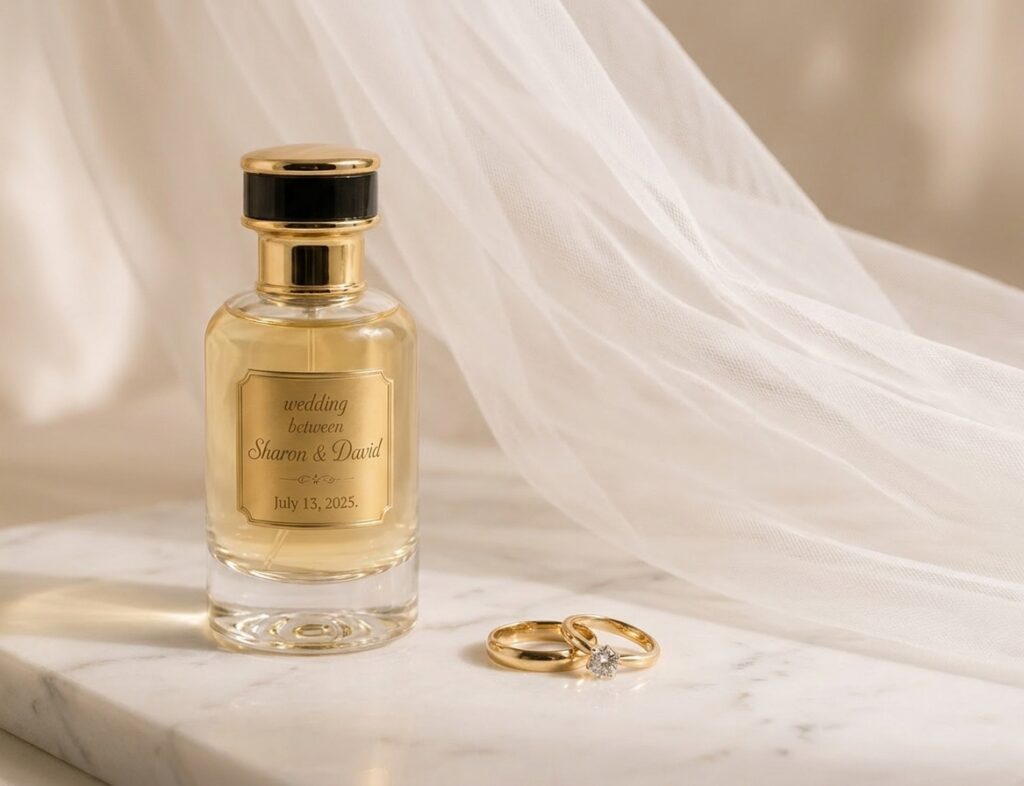
Event companies running 30+ events per year report a 22% reduction in vendor-management overhead when consolidating fragrance favors to a single Made-in-France supplier (2024 European events industry benchmark, n=87). MOQ 100 units with up to 4 SKUs per PO, 14-day production for in-stock references, DDP duty-paid shipping worldwide, and IFRA Amendment 51 / ISO 22716 compliance documentation included — operational fit for an events catalog spanning weddings, corporate galas, retreats, awards dinners, and milestone gifting. This guide breaks down the economics, lead times, and procurement workflows for purchasing managers evaluating perfume favors as a recurring SKU line in 2026.
Need a B2B sourcing pack with tier breaks across MOQ 100 / 250 / 500 / 1,000? WhatsApp our B2B desk: +33 6 17 74 77 13
Why Event Companies Consolidate Fragrance Favors to One Supplier
For an event company managing 30 to 120 events per year, fragrance favors typically appear in 40–60% of the production calendar — wedding contracts, corporate galas, year-end client gifting, executive offsites. Sourced ad hoc, that volume fragments across 4–8 vendors per fiscal year. Each vendor adds a customs entry on imports, a separate hazmat declaration (alcohol-based perfume is UN1170 / Class 3 dangerous goods), an independent payment cycle, and an isolated lead time variance.
Consolidating to a single supplier collapses that overhead into one ledger entry per quarter. One purchase order can carry up to four SKUs (e.g. 100 fresh aquatic for a beach wedding, 100 oriental woody for a corporate gala, 100 niche premium for an awards dinner, 100 fresh aromatic for a wellness retreat) under one customs declaration, one hazmat documentation pack, and one 50/50 payment schedule. Procurement teams typically reclaim 12–18 hours per quarter on vendor management alone, before factoring in reduced freight consolidation costs.
The compliance dimension matters equally. Reselling alcohol-based fragrance across borders requires IFRA conformity certificates, SDS sheets, and ISO 22716 cosmetic GMP documentation. A single supplier issues one harmonised compliance pack per PO. Multiple suppliers require manual reconciliation of differing certificate formats — a friction point that scales linearly with event count.
The 1,000+ Reference Library Mapped to Event Types
A catalog of 1,000+ ready-to-ship references is only useful when curated against event typology. The library segments along scent family, presentation format (15ml roll-on, 30ml spray, 50ml gift box), and price tier. The mapping below reflects how event companies typically allocate SKUs across their book of business:
- Weddings (beach / outdoor / spring-summer): soft floral, fresh aquatic, citrus aromatic. Format bias toward 15ml roll-on with custom kraft or vellum label. Per-unit DDP $3.20–$5.50.
- Weddings (luxury / venue / autumn-winter): oriental amber, oud-light, white floral with musk base. Format bias toward 30ml spray with foil-stamped label. Per-unit DDP $4.80–$7.80.
- Corporate galas (evening, formal): woody oriental, leather-tobacco, smoky vetiver. 30ml spray, embossed label, gift box optional. Per-unit DDP $5.50–$8.20.
- Awards dinners (niche premium tier): chypre, iris-suede, ambroxan-driven niche profiles. 30ml or 50ml, premium presentation. Per-unit DDP $7.00–$11.50.
- Retreats / wellness / offsites: fresh aromatic, herbal-green, mineral. 15ml roll-on, minimalist label. Per-unit DDP $2.80–$4.50.
- Holiday parties / year-end gifting: gourmand, spiced oriental, vanilla-amber. 15ml or 30ml, seasonal label. Per-unit DDP $3.40–$5.80.
- Executive gifting / milestone anniversaries: niche premium, signature scent, individually boxed. 50ml format. Per-unit DDP $9.00–$14.00.
- Brand launches / activations: custom-matched fragrance to brand identity, co-branded label. 15ml or 30ml. Per-unit DDP $4.20–$7.50.
Event companies typically lock in 6–10 reference SKUs as a “core catalog” used across 70% of contracts, with the remaining 30% drawing from the long tail for bespoke briefs.
MOQ 100 / 4-SKU Per PO Economics
MOQ 100 per reference, with up to four SKUs combined under a single purchase order, is the operational unit that makes consolidation viable for mid-volume event companies. A single PO of 4 × 100 units = 400 units total carries one freight booking, one customs entry, and one invoice. For an event company running 4 weddings, 2 corporate galas, and 1 retreat in a quarter, that single PO covers 7 events with one procurement transaction.
The 25-unit-minimum-per-reference rule (when splitting across SKUs within the 100-MOQ band) accommodates smaller events such as executive dinners or board retreats without forcing overstock. A typical quarterly PO for a mid-size event company might break down as: 250 fresh aquatic (3 spring weddings), 250 oriental woody (2 corporate galas), 100 fresh aromatic (1 retreat), 100 gourmand (1 holiday client gift) — 700 units across 4 SKUs, one PO, one customs clearance, 14-day lead.
Net per-event procurement time drops from 4–6 hours per event (vendor sourcing, sample approval, freight booking, customs follow-up) to 30–45 minutes (SKU selection from existing catalog, PO release).
Pricing Tiers DDP
All prices below are DDP (Delivered Duty Paid) — duties, taxes, and customs handling pre-paid by supplier. No customs broker engagement required at receiving entity.
| Guest count tier | $/unit DDP (15ml + custom label) | $/unit DDP (30ml + custom label) | Total favor budget |
| 100–149 | $4.50–$6.50 | $5.50–$7.80 | $550–$820 |
| 150–249 | $3.80–$5.50 | $4.80–$6.80 | $720–$1,200 |
| 250–399 | $3.20–$4.50 | $4.20–$5.80 | $1,050–$1,650 |
| 400–599 | $2.80–$3.80 | $3.80–$5.00 | $1,520–$2,400 |
| 600+ | $2.40–$3.40 | $3.40–$4.50 | $1,950+ |
For event companies operating on a markup model (typical 30–45% gross margin on favor SKUs passed to end client), the 250–399 and 400–599 tiers deliver the strongest unit economics. Aggregating across multiple events in a quarter to land in the 600+ tier is achievable when running consolidated POs.
Event Type × Scent Family × Format × Per-Unit DDP
| Event type | Scent family fit | Format recommendation | Per-unit DDP range |
| Wedding — beach / outdoor | Fresh aquatic, citrus aromatic | 15ml roll-on, kraft label | $3.20–$5.50 |
| Wedding — luxury venue | Oriental amber, white floral | 30ml spray, foil-stamped label | $4.80–$7.80 |
| Corporate gala — evening | Woody oriental, leather | 30ml spray, embossed label | $5.50–$8.20 |
| Awards dinner | Niche premium, chypre, iris | 30ml or 50ml, gift box | $7.00–$11.50 |
| Retreat / wellness day | Fresh aromatic, herbal-green | 15ml roll-on, minimal label | $2.80–$4.50 |
| Holiday party | Gourmand, spiced oriental | 15ml or 30ml, seasonal label | $3.40–$5.80 |
| Executive gift | Niche signature | 50ml, individual box | $9.00–$14.00 |
| Milestone anniversary | Oriental, white floral, oud-light | 30ml, premium label | $5.20–$8.50 |
| Brand launch / activation | Custom-matched to brand | 15ml or 30ml, co-branded label | $4.20–$7.50 |
| Charity gala | Mid-tier oriental or floral | 30ml spray, branded label | $4.50–$6.80 |
This matrix is designed to be lifted directly into a procurement deck or a client-facing event proposal as a SKU-line reference.
Lead Time vs Broker Comparison
Direct supplier production lead time on in-stock references is 14 days from PO confirmation to dispatch, plus 3–7 days DDP transit depending on destination. Total receipt-ready window: 17–21 days.
Broker-channel lead time on equivalent references typically runs 5–8 weeks (35–56 days). The differential reflects the broker’s own procurement cycle (broker orders from manufacturer after receiving client PO), additional QC pass, re-labeling time, and consolidated freight wait.
For event books operating on a 60-day client lead time (industry standard for weddings and corporate galas), the 14-day direct lead leaves 46 days of buffer for sample approval, label proofing, and contingency. The 35–56 day broker lead leaves 4–25 days of buffer — operationally fragile when client-side approval cycles slip.
For shorter-lead-time events (corporate activations, last-minute exec gifting at 21–30 day notice), only the direct 14-day channel is viable.

DDP Shipping for International Events
DDP (Delivered Duty Paid) Incoterms transfer all customs, duty, and tax obligations to the supplier. The receiving event company books no customs broker, files no import declaration, and pays no separate duty invoice. For event companies headquartered in one country and producing events in another (US-headquartered company producing a wedding in Mexico, UK-headquartered company producing a gala in Dubai, French company shipping to a corporate retreat in Switzerland), DDP collapses three potential customs entries into one.
Hazmat documentation for UN1170 alcohol-based fragrance is supplied as part of the DDP pack: SDS, IATA dangerous goods declaration (for air freight), ADR documentation (for European road freight). Receiving entity handles no dangerous goods paperwork.
DDP also stabilises landed cost. Quoted per-unit DDP price is the final per-unit cost — no post-shipment surprises from duty rate changes, customs broker fees, or destination-country VAT reclassifications.
Quarterly forecast on the table? Pull a consolidated quote across multiple events in one request. Request a quote → or WhatsApp +33 6 17 74 77 13
Custom Labeling at Zero Setup Cost
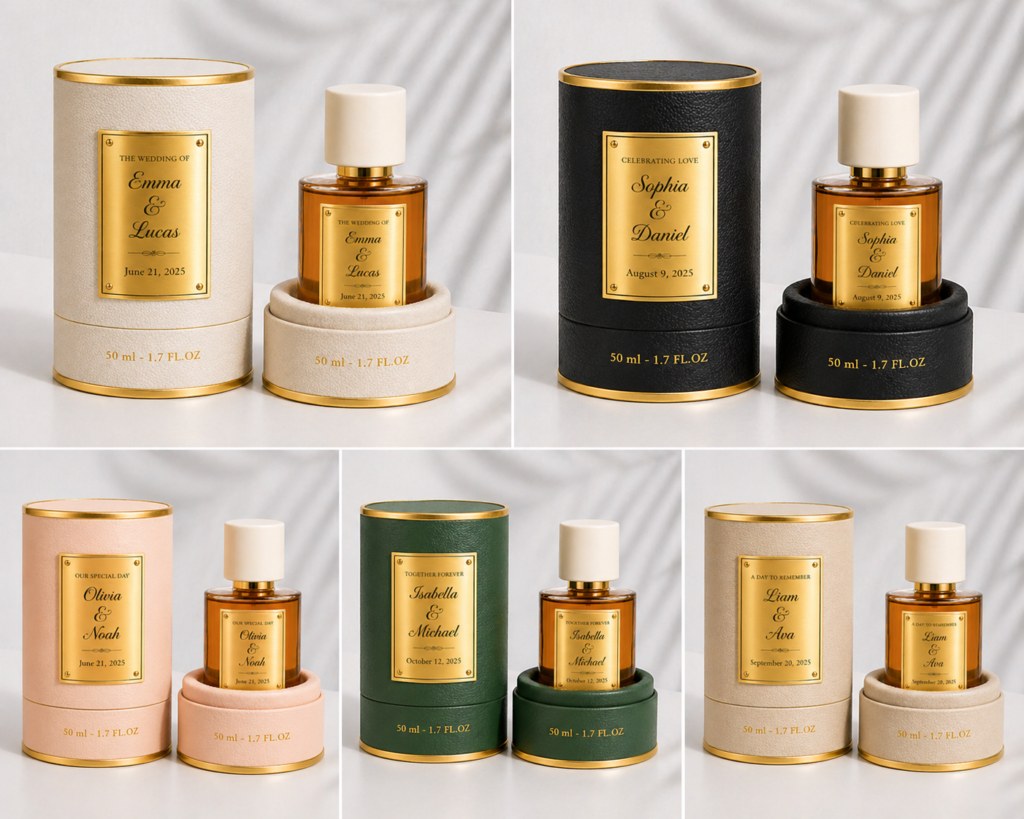
Custom labels are produced in-house with no setup fee, no plate fee, and no minimum re-order. For event companies, this enables co-branded labels combining the event company’s brand mark with the end client’s identity (couple’s monogram, corporate logo, gala visual identity).
Lead time for custom label production is included within the 14-day production window — no separate label-print lead. File specs accepted: AI, EPS, PDF (vector); 300dpi PNG/TIFF for raster artwork. Standard label substrates: matte coated paper, kraft, vellum, foil-stamped, embossed. Print methods: digital, foil stamp, deboss/emboss.
For event companies presenting a “white-label” service to end clients, the zero-setup-cost label policy means a 100-unit boutique wedding favor and a 600-unit corporate gala favor carry the same per-unit label economics. Margin is preserved on small-event bookings.
Sample Kit Availability for Portfolio Presentation
A B2B sample kit (12 reference scents, 2ml vials, presentation case) is available for event companies maintaining a physical sample library for client pitch meetings. Kit ships within 5 business days. Standard sample-kit charge is creditable against the first PO above MOQ 100.
For event companies running quarterly client portfolio reviews, refresh kits with new seasonal references are issued each quarter. This supports the practice of presenting fragrance favors as a curated SKU line during client onboarding rather than as an ad-hoc add-on at event week minus 4.
Why Wedding Perfume Favors Fits Event Company Sourcing Operations
- Single-supplier consolidation: 1,000+ references on one supplier code, one master service agreement, one accounts-payable record. Eliminates 4–8 redundant vendor onboardings per fiscal year.
- IFRA Amendment 51 / ISO 22716 compliance pack included: standardised compliance documentation issued per PO. Acceptable for resale documentation in EU, UK, US, Canada, Australia, GCC.
- DDP one-customs-entry shipping: duty-paid worldwide. No broker engagement at receiving entity. Landed cost is the quoted price.
- 14-day predictable lead time on in-stock references: versus 5–8 weeks via broker channels. Compatible with 30–60 day event lead times without contingency stress.
- Dropshipping option for e-commerce events businesses: for event companies operating an online favor configurator or last-mile direct-to-recipient gifting, dropship handles per-unit fulfillment to end recipient with branded packaging. No inventory holding required at event company warehouse.
- 50% deposit / 50% on shipment confirmation: payment terms aligned with event-company cash cycle. Net 30 terms available on accounts above $25,000 trailing-12-month spend.
- Zero-setup-cost custom labels: scales economically from 100-unit boutique bookings to 1,000+ unit corporate programs.
Common Mistakes Event Companies Make Sourcing Fragrance Favors in 2026
- Splitting 4 events across 4 brokers. Result: 4 customs entries, 4 hazmat documentation fees, 4 timeline risks, 4 invoices to reconcile. Consolidating to one supplier with a 4-SKU PO collapses this to one of each.
- Ignoring IFRA Amendment 51 documentation when reselling internationally. Customs delays, end-client resale liability, and post-event compliance challenges become the event company’s exposure. Always require IFRA conformity, SDS, and ISO 22716 documentation in the supplier intake checklist.
- Booking favors at event week minus 4 through a broker. Broker channel needs 5–8 weeks. The result is either rushed substitution (off-brief scents, wrong format) or expedite-fee escalation. Direct supplier 14-day lead absorbs this scenario; broker channel does not.
- Quoting favors EXW or FOB to end clients without modeling DDP landed cost. Margin compression of 8–14% on cross-border events is typical. Always quote DDP from the supplier and pass DDP to the end client.
- Ordering MOQ stock without aligning to a curated core catalog. Result: 6 partial-pallet leftover SKUs after the season closes, no resale path, write-down on inventory. A curated 6–10 SKU core catalog rotated against event typology eliminates leftover stock.
What This Means for Your Events Procurement
- Lock in a curated 6–10 SKU core catalog mapped to your top event types. Issue one supplier MSA covering MOQ 100 / 4-SKU per PO terms, IFRA Amendment 51 compliance pack, DDP Incoterms, and 50/50 payment. Convert ad-hoc favor sourcing into a recurring procurement line.
- Consolidate quarterly POs across multiple events. Aggregate 3–6 events per PO to land in the 400–599 or 600+ pricing tier. Reclaim 12–18 hours per quarter on vendor management. One customs entry per quarter, not per event.
- Order a B2B sample kit before the next client portfolio review. Present fragrance favors as a curated SKU line during client pitch, not as an event-week add-on. Convert favor procurement from cost center to margin contributor at 30–45% gross.
Pull a B2B quote with MOQ tier breaks, IFRA documentation, and DDP landed cost — same business day. Request a B2B quote → or WhatsApp +33 6 17 74 77 13
Continue Your Research
- Wedding Perfume Favors — pillar overview
- Wedding Planner Perfume Favors — B2B sourcing for planners
- Bulk Wedding Perfume Favors — volume tier economics
- Wholesale Wedding Perfume Favors — wholesale pricing structure
- Corporate Wedding Perfume Favors — corporate event programs
- Wedding Perfume Favor Labels — custom labeling specs