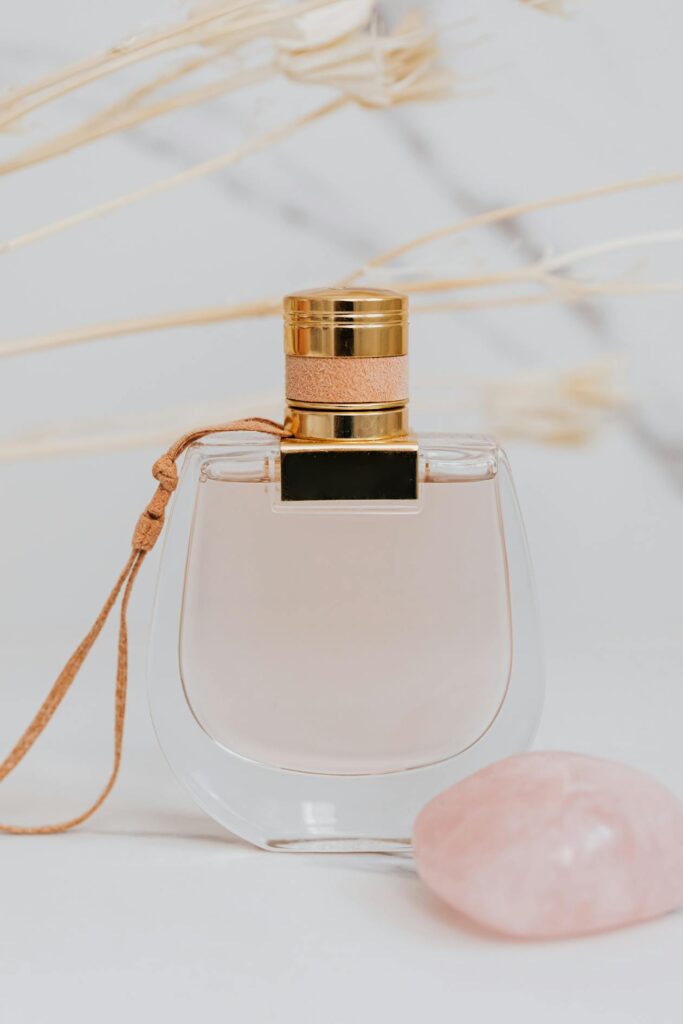
Vintage-themed weddings represent 17% of Pinterest wedding inspiration boards as of 2024-2025, with manor houses, antique-store venues and heritage estates leading the search trends for 2026 ceremonies. The aesthetic’s signature olfactive language — powdery iris, violet, heliotrope, aldehydic florals and soft musk — draws directly from 1920s-1960s French perfumery’s golden era, the period that defined what “elegant” smelled like for three generations of brides. These accords are available at $4.50-$7.80/unit DDP through Made-in-France manufacturers maintaining the classic compositions in IFRA-compliant modern formulation, with custom sepia-tone labels at zero setup and a 14-day production window from artwork sign-off.
Ready to discuss your vintage favor brief? WhatsApp +33 6 17 74 77 13 — share your venue style, era inspiration and guest count for a same-day quote.
Vintage Perfumery’s Heritage: The Golden Era of Powdery, Iris-Led Classics
To create a perfume favor that genuinely evokes a vintage wedding — rather than simply attaching an old-looking label to a modern fragrance — you have to start with what perfumery actually smelled like during the eras you are referencing. The 1920s flapper years introduced aldehydes: those sparkling, soapy, slightly metallic top notes that gave fragrances a champagne-like effervescence and were paired with powdery iris and rose absolute. The 1940s and 1950s, often called the starlet decade, refined the chypre and the powdery floral — violet, heliotrope, soft musk and orris butter became the signature of the well-dressed bride. The 1960s “mod” wave kept the powder but lightened it with cleaner musks and softer woods.
What unifies all four decades is restraint. Vintage perfumery rarely shouts. It hovers close to the skin, leaving behind a soft, slightly cosmetic veil — the smell, in many people’s memory, of a grandmother’s dressing table, an antique velvet purse, a hand-written letter pressed between book pages. For a wedding favor at a heritage estate or antique-store venue, this is exactly the register you want: warm, intimate, period-correct, never overpowering the church flowers or the dinner.
The Vintage Palette: Powdery + Iris + Violet + Heliotrope + Soft Musk
The five-pillar olfactive identity for a vintage wedding favor in 2026 is precise and historically grounded. Each note carries a specific role:
- Powdery accord — the base register that ties the composition to its era. Built from orris (iris root), benzoin and soft synthetic powders, it produces the cosmetic, slightly cool, slightly cushioned feel of a vintage face powder.
- Iris (orris butter) — the most aristocratic raw material in classical perfumery. Cool, slightly carrot-like, suede-textured. It is the spine of the powdery family and was the signature of countless 1940s-50s couture fragrances.
- Violet (ionones) — green at the top, candied at the heart. Violet gives the composition its romantic, slightly melancholic charm and pairs beautifully with iris.
- Heliotrope — almond-vanilla-marzipan, but never gourmand-heavy. It softens the iris-violet axis and produces that “old letter, old lace” warmth without crossing into modern dessert territory.
- Soft musk — clean, skin-like, slightly cottony. The white musks used today are IFRA-compliant successors to the animalic musks of the original era and carry the dry-down for hours.
Optional supporting players, used sparingly: aldehydes for a 1920s wink, vintage rose absolute, a touch of soft amber kept resolutely powdery rather than warm. Strictly avoided in this palette: patchouli, oud, sea-salt accords, fig leaf, prominent cedar, smoky leather — these belong to other aesthetics and break the period feel instantly.
Format Strategy: Compacts, Antique-Style Bottles, Period Atomizers
Format is where vintage favors either land beautifully or feel like a costume. Three formats work, each tied to a specific wedding moment.
The solid compact 5-10g is the most period-correct option available today. Vintage perfumery was distributed in solid form throughout the 1920s-1950s — wax-and-jojoba compacts in small metal cases were carried in evening purses by every fashionable bride. A modern solid compact in an antique-finish tin (brushed brass, aged silver, mother-of-pearl effect lid) reads instantly as heritage. It also solves real logistical issues: no liquid, no leakage, TSA-friendly for destination guests, and the format itself is the storytelling object.
The antique-glass-style 15ml bottle offers a more traditional favor silhouette. Manufacturers’ libraries include flacon shapes inspired by 1920s art-deco angles, 1940s apothecary rounds and 1950s hourglass forms, with frosted or smoked-glass finishes that mimic patinated antique perfume. A small atomizer or a glass dab-stopper completes the look. This is the hero format if your favor table is itself part of the venue’s visual story.
The period-style atomizer 30ml is reserved for VIP gifts — bridal party, parents, officiant. Squeeze-bulb atomizers with silk tassels, faceted glass and engraved collars carry the highest perceived value and are kept long after the wedding as dressing-table objects.
Pricing Tiers DDP — The 2026 Vintage Favor Reference
Pricing below is delivered duty paid (DDP) to the EU, UK or US, MOQ 100 units, 14-day production from artwork approval, custom sepia-tone label included at zero setup. Payment is 50% deposit, 50% before shipping.
| Format | Volume | Per-unit DDP | MOQ | Best for |
| Solid compact (basic tin) | 5g | $4.50 | 100 | Period-correct mass favor, antique sideboard display |
| Solid compact (antique-finish tin, etched lid) | 8-10g | $5.40 | 100 | Heritage-estate weddings, mid-tier signature gift |
| Antique-style glass vial, dab-stopper | 10ml | $5.80 | 100 | Apothecary-era 1920s aesthetic, parchment-tag favor |
| Antique-style glass bottle, micro-atomizer | 15ml | $6.60 | 100 | Hero favor on dressing-table-style display |
| Faceted glass + silk tassel atomizer | 30ml | $7.80 | 50 | VIP and bridal-party gift, kept as dressing-table object |
All prices include juice, primary packaging, custom front and back label, IFRA documentation, INCI listing, batch traceability and DDP transport. No setup fees, no plate fees, no minimum-order surcharges.
Vintage Era × Signature Accord × Format Pairing
The richness of the vintage aesthetic is that “vintage” is not one thing — it is at least four distinct visual and olfactive worlds. Match your venue and your dress to the right decade and the favor reads correctly.
| Era | Visual cue | Signature accord | Recommended format |
| 1920s flapper | Art-deco geometry, beaded tulle, brass | Aldehydic powder + iris + soft rose | Antique-glass 10-15ml, art-deco label, sepia ink |
| 1940s starlet | Old-Hollywood satin, ivory gloves, pearls | Iris + violet + heliotrope + soft musk | Solid compact 8-10g, brushed-brass tin, hand-script label |
| 1950s old-Hollywood | Full-skirt couture, lace, mother-of-pearl | Powdery rose + orris + soft amber-powder | Hourglass 15ml frosted glass, deckle-edge label |
| 1960s mod-romance | Clean lines, simple satin, soft minimalism | Clean iris + light violet + cottony musk | Solid compact 5g, mother-of-pearl lid, minimalist label |
If you cannot decide between two adjacent decades, the 1940s starlet palette is the safest crowd-pleaser — it sits squarely in the centre of the powdery-iris-violet axis and reads as “vintage” to virtually every guest regardless of their personal reference.
Label Design: Sepia, Period Typography, Hand-Script Ink, Deckle-Edge
The label does roughly half the storytelling work on a vintage favor — guests read the label before they smell the juice. Four design choices carry the period feel.
Sepia and aged tones. Print on cream, ivory or warm-buff stock rather than bright white. Inks are kept to sepia brown, faded burgundy, soft aubergine and antique gold foil — no cool greys, no modern black-on-white.
Period typography. A serif headline (Didone or transitional, echoing 19th-century book typography) paired with a hand-script secondary line. Avoid modern geometric sans-serifs entirely. The script should look ink-dipped — slightly variable line weight, the occasional ink-pool, never digitally perfect.
Hand-script ink and period illustration. A small engraved-style botanical motif (iris stem, violet sprig, monogrammed cypher) sits well in the corner. These can be supplied from the manufacturer’s library or drawn from your wedding stationery suite for full coherence.
Deckle-edge paper effect. Modern label printers can simulate the soft, torn edge of hand-cut letterpress paper. This single detail elevates the favor from “themed” to “considered” and costs nothing extra.
All four choices are included in the zero-setup custom label offer. Three rounds of artwork revisions are standard before the 14-day production clock starts.
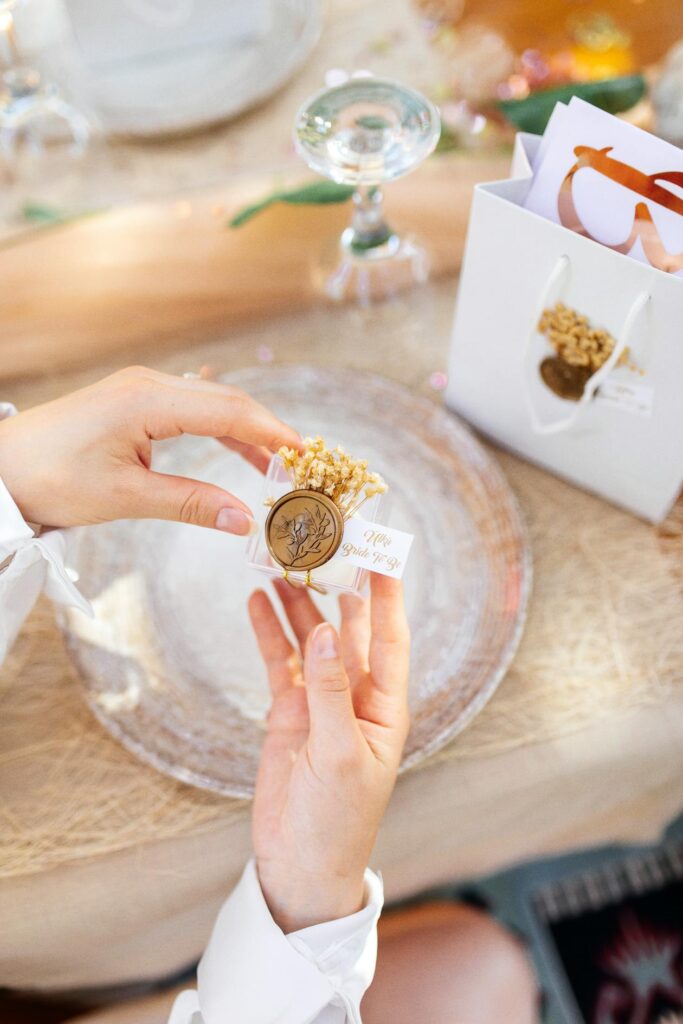
Packaging: Antique Boxes, Parchment Liners, Wax-Seal Closures
Outer packaging is the third storytelling layer. The perfume itself, the label, and then the way the guest unwraps the object. Three elements are worth the modest extra cost.
Antique-style outer boxes. Kraft or aged-cream board, gently distressed, sometimes with a window cut to reveal the bottle or compact inside. Avoid glossy laminates entirely.
Parchment or vellum liners. A single sheet of translucent paper folded around the bottle, tied with a thin satin or grosgrain ribbon, adds the unmistakable feel of a wedding gift wrapped in the 1940s. Champagne, ivory and dusty rose ribbons match the powdery palette.
Wax-seal closures. A small wax seal — burgundy, antique gold, or sepia — pressed with the couple’s monogram or initials closes the parchment. This is the photo detail guests will share on social media, and it costs roughly $0.30 per favor at scale.
Day-Of Logistics: Antique Sideboards, Vintage Trays, Heirloom Display
How favors are presented on the day matters as much as how they are made. Vintage weddings reward staged, layered presentation rather than the modern flat grid.
Use antique sideboards if your venue has them — most heritage estates and manor houses do. A long oak or walnut sideboard dressed with a lace runner, two silver candelabras and the favors arranged in soft clusters reads instantly as period-correct. Vintage silver trays (real or convincing reproductions) hold the favors at varied heights using stacked books or fabric-draped risers underneath.
If you prefer a more intimate touch, place the favor at each place setting atop a folded linen napkin with a hand-written name card on parchment. The favor then becomes part of the table styling rather than a take-away station.
For destination weddings, the favors ship DDP directly to your venue or planner address — no customs admin on your side. Plan to arrive at the venue 2-3 working days before the ceremony to allow the boxes to acclimatise and to assemble parchment-and-wax-seal trim on site if you have chosen those finishes.
WhatsApp +33 6 17 74 77 13 to share your venue, your era of inspiration and your guest count — we will reply within working hours with a full quote, fragrance options from the vintage-style library, and label mock-ups.
Why Wedding Perfume Favors Fits Vintage Weddings
Several specific aspects of the manufacturer’s offering align unusually well with the vintage-aesthetic brief.
Solid compact format echoes vintage perfumery directly. The 5-10g solid compact in an antique-finish tin is not a costume — it is a faithful continuation of the format that was the most common way to carry perfume from roughly 1920 to 1955. No other format on the modern market is as historically correct.
Period-style labels at zero setup. Sepia-tone printing, hand-script secondary text, deckle-edge effect and engraved-illustration cyphers are all included in the standard custom-label offer. There are no plate fees, no setup charges, and three artwork revision rounds are standard.
IFRA-compliant modernization of vintage accords. Some original raw materials of the golden era — certain natural musks, oakmoss at unrestricted levels, nitro-musks — are no longer permitted. The library compositions reproduce the period feel using modern compliant alternatives so the favor smells vintage without breaching any 2026 EU, UK or US regulation.
1,000+ reference library includes vintage-style accords. French powdery florals, classic chypres, aldehydic florals and orris-led compositions are pre-developed and ready to scent at MOQ 100 with the 14-day window — no custom-development time required, no surcharge.
Common Mistakes Couples Make on Vintage Wedding Perfume Favors in 2026
Five recurring errors come up in vintage-favor briefs. All five are avoidable with the right partner.
- Trying to source actual vintage perfume bottles from antique markets. Original 1920s-1950s flacons fail modern IFRA and child-safety regulation, are nearly impossible to ship as hazmat, and the residue of their original juice contaminates any new fill. Use modern reproduction glass with the period silhouette instead.
- Matching label aesthetic but using a modern fresh accord. A sepia label with a wax seal that opens to reveal a sea-salt-and-fig-leaf modern fragrance breaks the period feel in two seconds. The juice has to match the visual register — powdery iris, violet, heliotrope, soft musk only.
- Choosing a fragrance that is too quiet to perceive. Vintage powdery accords are subtle by design. If the compact is opened in a noisy ballroom three hours into the reception, guests may struggle to read the fragrance. Test the favor in a calm room beforehand and consider a slightly higher concentration (eau de parfum rather than eau de toilette) for the solid compact format.
- Ordering bright-white labels. Pure white paper is a 1990s-2010s aesthetic. Cream, ivory or warm-buff stock with sepia ink is roughly five times more period-appropriate at identical cost.
- Forgetting the wax seal needs to be applied at room temperature. If your venue is warm or outdoor, and the favors are pre-sealed three weeks earlier, the wax can soften and smudge. For warm-weather weddings, ship the favors sealed but apply the wax on site or use the cold-cast resin alternative.
What This Means for Your Wedding
Three concrete actions move a vintage-favor project forward.
- Decide your decade first. 1920s, 1940s, 1950s or 1960s — each has a distinct visual and olfactive register. Pick one and align dress, stationery and favor around it rather than mixing.
- Choose format before fragrance. Solid compact for period correctness, antique-glass 15ml for hero presentation, atomizer 30ml for VIP gifts. The format determines which accords from the library will sit best in that container.
- Brief the manufacturer with images, not adjectives. Send three photos — your venue, your dress, your stationery — over WhatsApp. The fragrance and label proposals will come back tighter and faster than from a written brief alone.
Final CTA
WhatsApp +33 6 17 74 77 13 with your guest count, your era of inspiration and a photo of your venue. You will receive a same-day quote with three fragrance suggestions from the vintage-style library, format pricing DDP to your country, and label mock-ups within 48 hours. Or request a written quote at https://www.weddingperfumefavors.com/request-a-quote.
Continue Your Research
- Pillar overview: /wedding-perfume-favors/
- Neighbouring aesthetics: /luxury-wedding-perfume-favors/ — /luxury-black-tie-wedding-perfume-favors/ — /garden-wedding-perfume-favors/
- Customization deep-dive: /wedding-perfume-favor-labels/ — period typography, sepia inks, deckle-edge paper effect
- Practical resources: /perfume-favor-bottles-wedding/ — antique-style bottle silhouettes — /wedding-perfume-favor-packaging/